


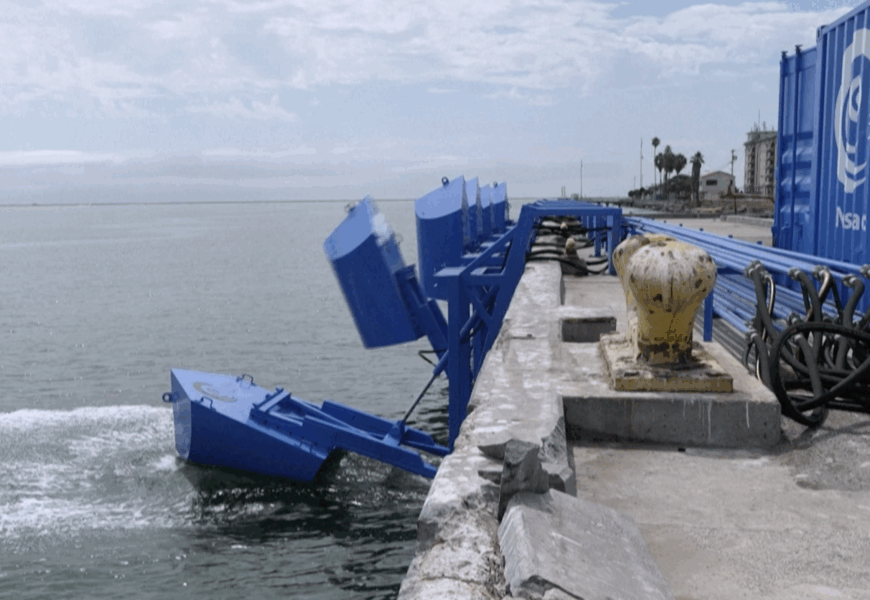
Along a pier in Los Angeles, a pioneering project seeks to harness the endless power of the sea to produce clean energy.
Blue metal floaters fixed to the dock at the Port of Los Angeles rise and fall with the motion of the Pacific waves. Their oscillations are not wasted: they are converted into electricity by an innovative system that may hold one of the keys to the global energy transition. Developed by Eco Wave Power, an Israeli start-up, this pilot project aims to prove that wave energy, often dismissed as unviable, can become a credible renewable solution.
According to Inna Braverman, co-founder of the company, the technology is deliberately simple. The floaters, attached to hydraulic pistons, compress a biodegradable fluid that feeds into a container filled with accumulators. The pressure is then released to drive a turbine, generating electricity. Unlike large offshore devices that are constantly exposed to destructive conditions, this installation is fixed to the pier and retracts when waves become too strong, avoiding damage during storms.
Eco Wave Power hopes to expand the concept on a much larger scale. Covering the 13-kilometer breakwater that shields the Port of Los Angeles with several hundred floaters could produce enough electricity to power around 60,000 homes. Braverman is convinced that wave power can become a “stable, large-scale renewable energy solution” and complement solar and wind power, both of which depend heavily on weather and daylight.
Challenges and prospects
Wave energy has long been viewed as the poor cousin of renewables. The United States Department of Energy estimates that waves along the West Coast could in theory supply electricity to 130 million households, covering about a third of the country’s needs. Yet decades of experiments have produced more failures than successes. Companies struggled to design machines robust enough to withstand the fury of the sea while also transmitting power to the grid through costly undersea cables. Most prototypes, placed far offshore, proved too expensive and too fragile to operate.
For Braverman, locating the system close to shore changes the equation. “Ninety-nine percent of competitors installed their devices in the middle of the ocean. It costs a fortune, and they keep breaking down,” she explains. “Our model avoids these problems and allows real scalability.” The idea appeals to experts such as Krish Thiagarajan Sharman, professor of mechanical engineering at the University of Massachusetts. He points out that maintenance has always been the Achilles’ heel of wave energy: “Being able to walk along a pier to inspect the system makes a lot of sense.” Still, he warns that such long jetties are rare, limiting opportunities for replication.
Despite these reservations, Eco Wave Power is moving forward. In Israel, about 100 homes in the port of Jaffa have already been powered by wave energy since December. In Portugal, 1,000 households in Porto are expected to benefit from the system in 2026. Projects are also planned in Taiwan and India, while 77 potential sites have been identified in the United States. Braverman dreams of building 20-megawatt installations, the threshold needed to compete with wind energy in terms of cost.
The company also insists on the environmental neutrality of its technology. Because the floaters are attached to existing man-made structures, they do not further disturb the marine ecosystem. “Our devices are integrated into infrastructure that already alters the environment, so the impact is negligible,” Braverman argues. This claim has particular resonance in California, where the surge in electricity demand—fueled in part by the rapid expansion of artificial intelligence—has reignited interest in alternative renewable sources.
According to Jenny Krusoe, founder of AltaSea, which supported the project, completing the Los Angeles installation will take about seven years. This timeframe allows for the complex federal authorization process, despite political uncertainty in Washington. “Support for the energy transition may be weakened for the next few years,” she acknowledges, alluding to Donald Trump’s hostility toward renewables. “But things change, and we must stay on course.”