

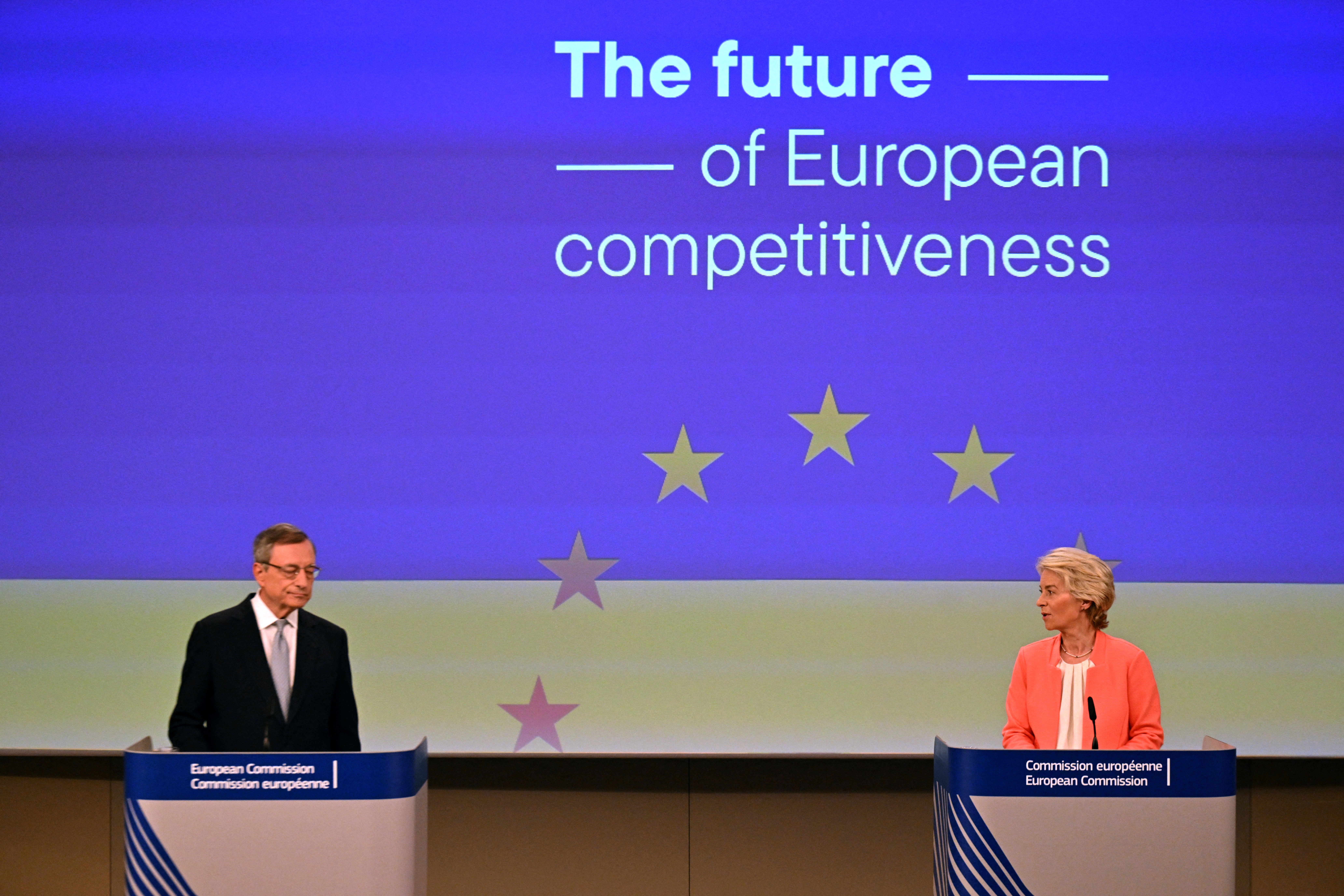
Former European Central Bank President Mario Draghi lamented on Tuesday the “slowness” of Europe in taking action to restore its competitiveness, one year after submitting a report calling for “radical reforms” to avoid economic decline.
“Businesses and citizens (…) are disappointed by Europe’s slowness, and its inability to move as fast” as the United States or China, he said in a speech in Brussels.
“Our growth model is eroding, our vulnerabilities are increasing, and the financing of the required investments is not clearly outlined,” noted the Italian economist, invited by the European Commission to provide an initial assessment twelve months after the publication of his recommendations.
Ue, Mario #Draghi suona l'allarme a un anno dal suo rapporto: la competitività europea è a rischio, serve un nuovo modello di crescita perché il nostro modello "sta svanendo, le vulnerabilità stanno aumentando e l'inazione minaccia la sovranità".
L'ex presidente Bce ha invitato… pic.twitter.com/ZMRXDKeF6b
— Class CNBC (@classcnbc) September 16, 2025
The trade standoff with the United States, as well as the debt levels of European countries, “have cruelly reminded us that inaction threatens not only our competitiveness, but also our sovereignty,” he further warned.
While praising the actions already undertaken and the Commission’s determination to push through numerous measures to get back on track, he regretted that “governments do not grasp the seriousness of the situation.”
“To carry on as before is to condemn ourselves to relegation. To move forward, we need to change speed, scale, and intensity,” he urged.
One year ago, Mario Draghi presented his report on competitiveness.
The first act of the new Commission was to translate it into policies and actions.
This is the urgency mindset we promised ↓
https://t.co/4G64HFxMKG— Ursula von der Leyen (@vonderleyen) September 16, 2025
For her part, Commission President Ursula von der Leyen acknowledged the need to accelerate reforms, while listing achievements over the past year—particularly in artificial intelligence, the revival of the defense industry, and the easing of regulatory burdens.
Along the way, she also took swipes at other European institutions, particularly Parliament, which has yet to adopt a series of regulatory simplification laws known as “Omnibus.”
“We need urgent action to address urgent needs, because our businesses and our workers cannot wait any longer,” she insisted.
She also called for the completion of the single market “with a sense of urgency,” a vast project aimed at removing by 2028 the numerous internal barriers that continue to hinder economic activity in many sectors.
She cited an estimate by the International Monetary Fund, according to which these intra-European barriers amount to the equivalent of 45% tariffs on goods and 110% on services.